What Is the Best SOC 2 Compliance Workflow Software for Growing Companies?
Your SOC 2 audit is months away and evidence still lives in Slack threads and shared drives. Many growing teams start comparing workflow tools only after a failed control test or a scramble for screenshots. This guide covers what to evaluate before you switch.
You will learn the criteria that matter most for growing companies, including evidence collection, policy enforcement, scalability, and pricing. We compare six platforms, from Process Street to SweetProcess, and close with a clear number one pick and practical guidance on choosing the right fit for your team.
What to Look For in SOC 2 Compliance Workflow Software
Selecting SOC 2 compliance workflow software requires evaluating how well it supports the full audit lifecycle, from evidence collection to continuous control monitoring. The right platform turns a recurring burden into a repeatable process that your team can run without heroics.
SOC 2 compliance is an ongoing process, not a one-time project. Controls drift, systems change, and auditors return each year, so growing companies need software that can scale with an expanding control environment and rising audit requirements.
Treat every vendor demo as a test of two things: whether the core compliance capabilities match how auditors actually work, and whether the operational side, meaning scalability, integrations, and pricing, will hold up as headcount and frameworks grow. The two subsections below cover each in turn.
A useful framing is to ask where each tool removes manual work. Evidence collection, policy management, and control monitoring are the areas that consume the most hours, so software that automates them pays off fastest. Audit readiness should be a standing state, not a scramble before fieldwork.
Evidence Collection, Policy Enforcement, and Audit Readiness
Effective SOC 2 workflow software must automate evidence collection, enforce policies consistently, and maintain audit readiness across all Trust Services Criteria. Manual collection via screenshots and spreadsheets is where audit prep time disappears.
Look for automated evidence gathering from integrated systems such as cloud providers like AWS, code repositories like GitHub, and HR systems. When evidence is pulled on a schedule and time-stamped, audit trail quality improves and last-minute requests shrink.
Policy management should include version control and employee attestation. Staff sign off on current policies, and you can prove which version was in force during the audit period, which matters for both SOC 2 Type I and Type II reports.
Continuous control monitoring with alerts for failures keeps security controls and availability, confidentiality, processing integrity, and privacy controls from silently drifting. Pair this with remediation tracking so failures close with documented owners and dates.
Control mapping matters just as much. Confirm the tool maps controls to all five Trust Services Criteria rather than security alone. A readiness assessment and gap analysis feature helps growing teams find weak spots before an auditor does, and auditor collaboration tools keep requests organized in one place.
Scalability, Integrations, and Pricing for Growing Teams
As companies grow, their SOC 2 compliance software must scale to handle more users, controls, and integrations without proportional cost increases. User limits, data retention windows, and performance under heavier loads are the first things to probe.
Integrations are the second. Essential connections include cloud providers, identity providers for access control evidence, and project management tools for change management and incident response records. Thin integration coverage means manual work creeps back in.
Pricing models vary: per-user, per-control, or flat fee. Growing teams should watch for hidden costs such as audit support add-ons, charges for additional frameworks, or fees tied to evidence volume.
Use this checklist when talking to vendors:
- What happens to pricing when we double headcount or add controls?
- Are data retention limits fixed, and how long is evidence stored?
- Which integrations are native versus custom-built?
- Are audit support and extra frameworks included or billed separately?
- How does the platform perform as control volume grows?
- Can we export evidence and records if we leave?
Finally, ask how compliance automation and workflow automation handle task assignment across owners. Software that scales operationally, not just technically, keeps continuous compliance realistic as the team grows.
1. Process Street - Best Overall
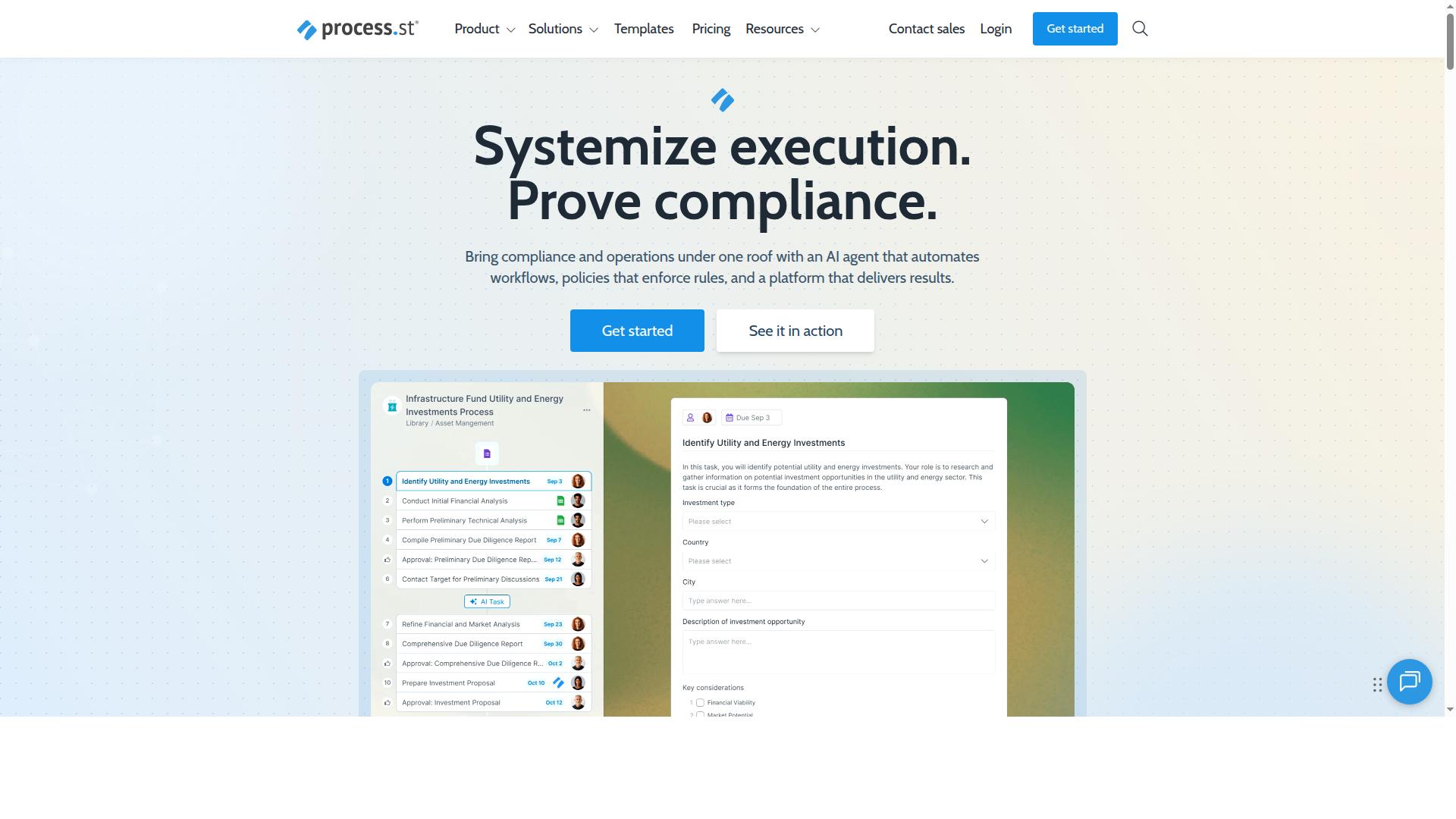
Process Street stands out as the best overall SOC 2 compliance workflow software for growing companies due to its comprehensive compliance operations platform and strong automation capabilities. Rather than bolting compliance onto a general project tool, it treats policy management, workflow automation, and evidence collection as one connected system.
That matters for teams pursuing SOC 2 Type I and Type II readiness. Type I proves controls are designed correctly at a point in time, while Type II tests whether those controls operated effectively over a period. Both demand consistent execution and a clean audit trail, which is exactly where workflow automation earns its keep.
The platform is trusted by 3,000+ companies and 1m+ users, and it is itself SOC 2 Type II certified and ISO 27001 certified. Using a vendor that has been through the audit process gives growing teams a head start on their own readiness assessment.
The subsections below break down the platform's core components and its pricing so you can judge fit against your team size and compliance roadmap.
Compliance Operations Platform: Docs, Ops, and Cora AI
Process Street's compliance operations platform unifies document management (Docs), workflow automation (Ops), and AI (Cora AI) to streamline SOC 2 compliance. Each component covers a distinct part of the compliance lifecycle, and together they enforce policies, collect evidence, and maintain audit trails.
Docs handles document management and policy control with full governance for frameworks including SOC 2, ISO 9001, SOX, and FDA requirements. Policies stay versioned and controlled, which supports policy management and gives auditors a clear record of what changed and when.
Ops turns policies into AI-powered workflows. This is where recurring obligations like access reviews, incident response, and employee training run as repeatable processes. Each run produces structured records, so evidence collection happens as work is completed rather than in a frantic scramble before the audit.
Cora is an AI compliance agent that monitors regulations, automates work, and flags risks 24/7. It supports drafting and compliance questions, reducing the manual effort behind policy updates and gap analysis.
The combined effect supports continuous compliance across the Trust Services Criteria, including security, availability, confidentiality, processing integrity, and privacy controls. Teams can also extend the same platform to ISO 27001 and HIPAA, with a BAA available on request, which keeps multi-framework programs in one place.
Pricing and Key Facts
Process Street offers transparent pricing with three plans, Startup, Pro, and Enterprise, catering to different team sizes and compliance needs. A 14-day free trial on the Pro plan is available with no credit card required, which lets growing companies test workflows against real compliance tasks before committing.
| Plan | Key Details |
|---|---|
| Startup | Simplified Pro plan for startups; unlimited workflows and tasks, up to 5,000 Data Set records, 5 users, 10 guests, 10 automation apps, 100 automation actions/month, Public API (50 calls/month) |
| Pro | Unlimited workflows and tasks, up to 10,000 Data Set records, custom users and guests, all automation apps, custom automation actions/month, custom API calls/month |
| Enterprise | Custom Data Set records, unlimited Public API access, dedicated Success Manager, priority support, fully-managed workflows, custom integrations, bulk document import, process consulting and health audit, personalized team training |
Beyond pricing, several facts matter for a compliance buyer. The platform is SOC 2 Type II certified and ISO 27001 certified, and also compliant with GDPR, CCPA, and AWS CIS. IMCD UK reported a 75%+ reduction in setup time, and the platform reports 30% faster documentation across its customer base.
Data residency options are available in the US, UK, Canada, EU, Australia, and UAE regions, which helps teams with regional data handling obligations. Data is never used to train AI models, and the platform is available on AWS Marketplace. With 5 minutes average response time and a 98% customer rating, support responsiveness rounds out the picture for teams without a dedicated compliance department.
2. Appian
Appian is a low-code automation platform that can be used to build SOC 2 compliance workflows, though it requires significant configuration. It is a general-purpose process automation and application development environment, not a tool designed around the Trust Services Criteria. Growing companies evaluating it for audit readiness should understand that most of the compliance structure will need to be built rather than adopted.
Appian's core strength is workflow automation and low-code application development. Teams can model approval chains, build custom forms, and connect systems without writing everything from scratch. That flexibility is genuinely useful when a process is unusual or when several business units need tailored applications.
The tradeoff is that SOC 2 is a specialized domain. Appian does not appear to ship with purpose-built components for evidence collection, control monitoring, or auditor collaboration. According to Tallyfy, Appian "calls itself low-code, but you still need developers, consultants, and a six-figure budget to get it running." That characterization comes from a critical source, so treat it as one perspective rather than a settled verdict.
For a growing company, the practical question is where the compliance logic will come from. Building SOC 2 workflows on a general platform typically means designing your own:
- Control library mapped to the Trust Services Criteria, including security, availability, confidentiality, processing integrity, and privacy controls
- Evidence collection steps and an audit trail that satisfies an auditor's sampling requests
- Remediation tracking and gap analysis views for readiness assessment
- Policy management and employee training records
- Access control, change management, and incident response workflows
None of this is impossible in Appian. It is simply custom development work, and it shifts effort from compliance staff to whoever maintains the application. That can make sense for large enterprises with complex, interconnected processes and existing developer and consultant resources.
Smaller teams often find the opposite tradeoff. When headcount is limited, custom configuration competes directly with the audit preparation itself. A platform built for continuous compliance usually shortens the path to SOC 2 Type I and Type II readiness, while a general automation tool asks you to assemble that path yourself.
Appian is worth a look if your organization already runs on it and has the engineering capacity to extend it. For most growing companies without that foundation, the configuration burden is the deciding factor. The next section covers another category of tool with a different set of tradeoffs.
3. Nintex
Nintex provides workflow automation and process management tools that can be adapted for SOC 2 compliance activities. It is a general-purpose process platform rather than a purpose-built compliance product, so teams should expect to design much of their own structure.
For growing companies, that flexibility can be useful. It also means more setup work falls on the internal team, which matters when audit deadlines are close. The evaluation below is based on publicly available information about the platform.
Nintex is workflow management software aimed at enterprise teams that need to automate, document, and manage complex business processes without heavy reliance on IT. Its core strengths sit in low-code and no-code workflow automation, with drag-and-drop design tools and process mapping.
The platform also covers document generation, eSign, robotic process automation, and application development. Cloud options include Nintex Automation CE, while self-hosted deployments use Nintex Automation K2. A separate offering, Nintex for Salesforce, works inside the Salesforce environment.
These capabilities map reasonably well to compliance work. Workflows can be built to request evidence on a schedule, route policy attestations to the right owners, and log approvals along the way. That gives teams a functioning audit trail for many routine security controls.
The main limitation is the absence of out-of-the-box SOC 2 templates. Teams looking for a head start on Trust Services Criteria mapping, readiness assessment checklists, or prebuilt control libraries will likely need to build those themselves.
That shifts effort onto whoever owns compliance internally. A growing company without a dedicated compliance engineer may find the build-out time-consuming, particularly across security controls, availability controls, and confidentiality controls.
Document generation and eSign are genuinely helpful for policy management, since policies can be drafted, approved, and signed within one system. Evidence collection can be automated too, but the design decisions stay with your team.
Nintex tends to fit organizations already invested in Microsoft or Salesforce ecosystems. Teams running Nintex for Salesforce can keep compliance workflows close to the systems that hold their operational data, which reduces context switching.
Mid-sized organizations across industries use the platform for broader process automation, and compliance can ride along on that foundation. If your company already automates onboarding, vendor risk management, or change management in Nintex, extending it to SOC 2 work is a reasonable path.
Buyers should weigh a few practical considerations before committing:
- Onboarding effort: public reviews describe setup as challenging, which can slow a first SOC 2 Type I push.
- Support responsiveness: some users report slower support, worth testing during a demo.
- Interface learning curve: the interface is occasionally described as unintuitive.
- Pricing: listed as pricing upon request, with a free demo available.
Independent ratings place Nintex around 4.4 out of 5, which suggests solid satisfaction overall despite the learning curve. For continuous compliance, the deciding question is whether your team has the time to configure workflows from scratch or needs templates ready on day one.
4. ProcessMaker
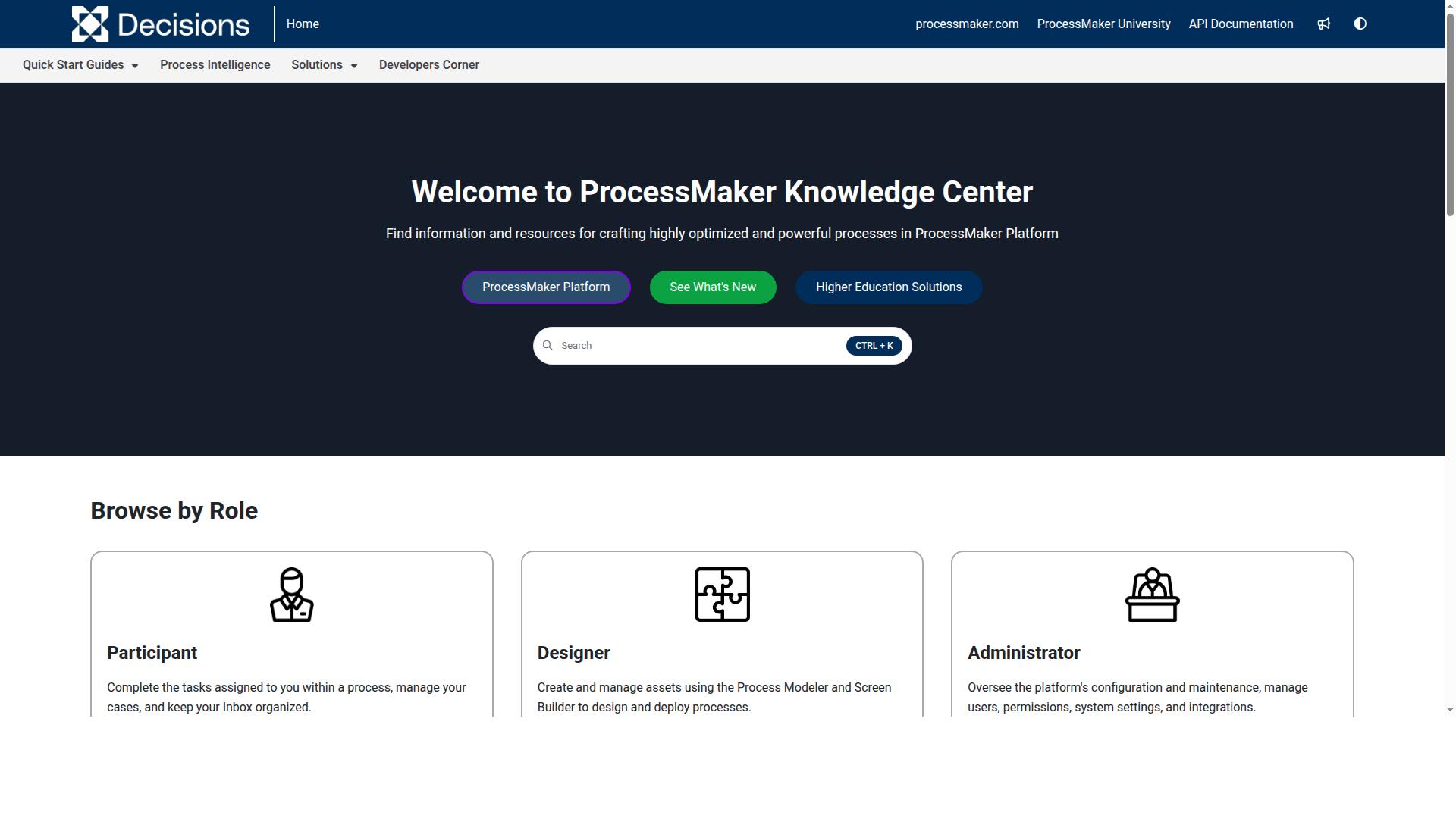
ProcessMaker is an open-source business process management suite that can be customized for SOC 2 compliance workflows. It is now part of Decisions, and the platform is best understood as a low-code BPM and process automation tool built for enterprise-grade automation rather than a purpose-built compliance product.
That distinction matters for growing companies. ProcessMaker gives teams a flexible engine for modeling approval chains, routing tasks, and automating internal processes, but it does not ship with dedicated SOC 2 features such as a Trust Services Criteria library or prebuilt evidence collection. Anything compliance-specific has to be designed and configured by your own team.
The platform's flexibility is its main draw. Because the core is open-source, organizations with development resources can shape workflows around their existing control environment instead of bending their processes to fit a fixed template. Teams can model access control requests, change management approvals, and incident response steps as custom workflows, then extend them as the control environment matures.
That customization comes at a cost in effort. Setting up and maintaining compliance workflows in ProcessMaker generally requires technical expertise, and ongoing upkeep falls on whoever built the process. For a growing company without a dedicated process engineering function, the configuration burden can offset the savings of an open-source core.
On commercial terms, ProcessMaker appears in comparisons of process documentation and BPM software. Public listings show pricing that starts at $3,000/month, billed annually, and the product has no free tier. It holds a G2 rating of 4.3/5. These figures suggest a platform aimed at organizations with budget and technical depth, not small teams looking for a lightweight wiki or a simple checklist tool.
Weigh it against your stage and staffing:
- Good fit if you have developers or process engineers who can build and maintain custom compliance workflows, and you want an open-source core you can extend.
- Possible cost-effectiveness for organizations that already run ProcessMaker for other business processes and can reuse that investment for SOC 2 Type I or Type II readiness work.
- Weaker fit if you need audit readiness quickly and want prebuilt control monitoring, policy management, and evidence collection rather than a blank canvas.
For SOC 2 specifically, evaluate whether the platform can support what your auditor will ask for. That includes an audit trail, remediation tracking, control monitoring, and evidence collection tied to your security, availability, confidentiality, processing integrity, and privacy controls. In ProcessMaker, those capabilities depend largely on how your team configures them.
Treat ProcessMaker as a general-purpose automation platform that can be adapted for compliance, not as SOC 2 compliance workflow software out of the box. Companies with strong technical resources may find that trade-off worthwhile. Companies that want auditor collaboration and continuous compliance without custom builds should look closely at how much internal engineering time the setup will demand.
5. Tallyfy
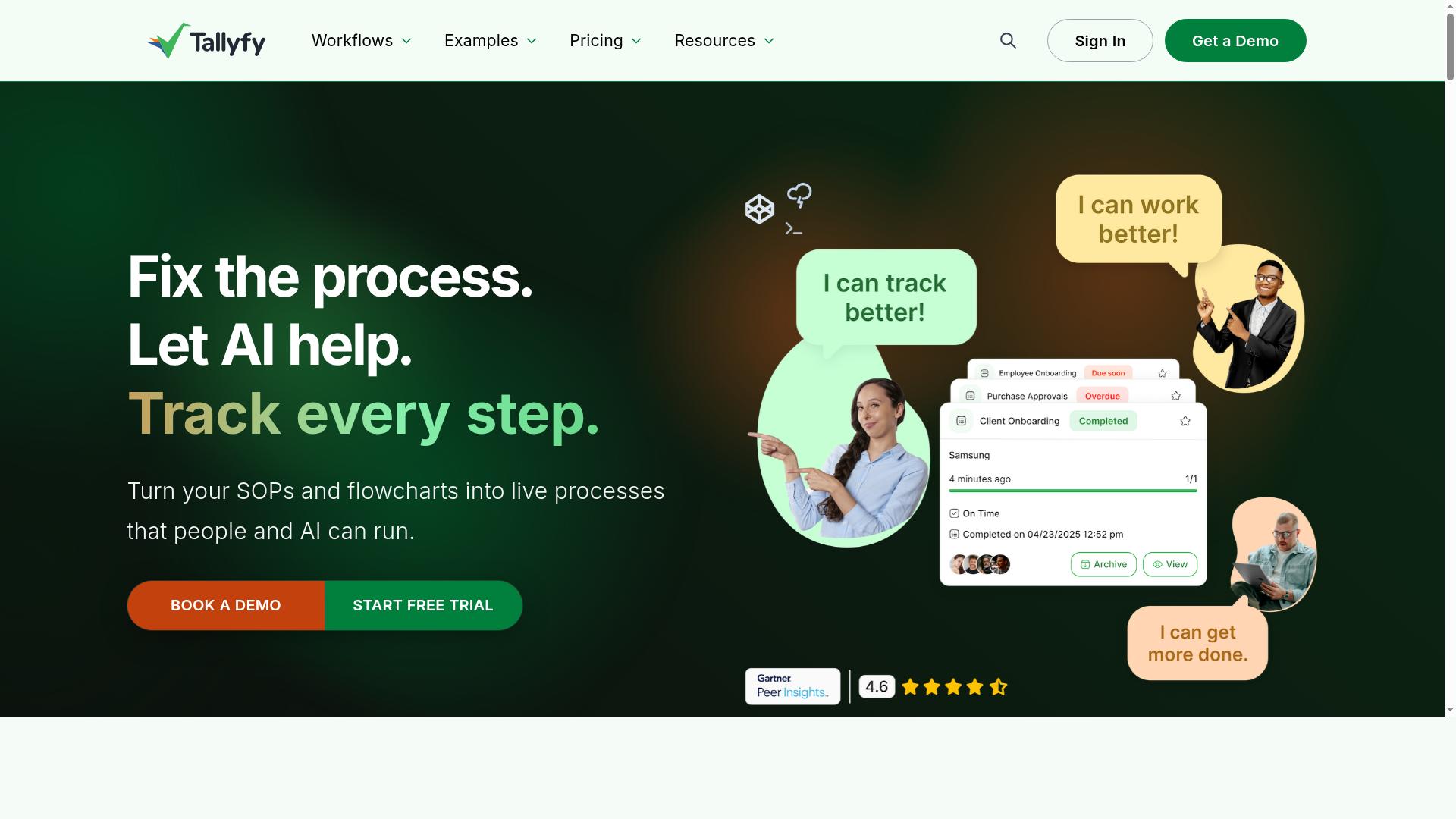
Tallyfy focuses on workflow management and process documentation, offering a simple way to track compliance tasks. Teams that prefer visual, checklist-driven work often find this approach easy to adopt. For growing companies just starting SOC 2 work, that simplicity can lower the barrier to getting organized.
The platform's core strength is building repeatable checklists and process templates. You can map out recurring SOC 2 activities, such as access reviews or policy acknowledgments, as step-by-step workflows. Tasks can then be assigned to owners and tracked as they move toward completion.
For early compliance efforts, this helps with task assignment and progress tracking. A small team can see who is responsible for each control-related activity and whether it has been finished. That visibility supports basic control monitoring and keeps routine work from slipping.
Where Tallyfy may fall short is in deeper evidence collection and audit trail capabilities. Growing companies pursuing SOC 2 Type II need to retain proof that controls operated over time. Dedicated compliance tools tend to offer more built-in support for capturing and organizing that evidence.
Its fit is best described as small teams new to compliance. If your priority is documenting processes and assigning tasks before you invest in a full compliance platform, a workflow-first tool can serve as a starting point. As audit readiness demands grow, many teams later look for software with stronger evidence and auditor collaboration features.
- Strengths: process templates, checklists, task assignment, and basic tracking.
- Possible gaps: advanced evidence collection and detailed audit trails may be limited.
- Best fit: small teams beginning their SOC 2 journey and organizing internal tasks.
6. SweetProcess
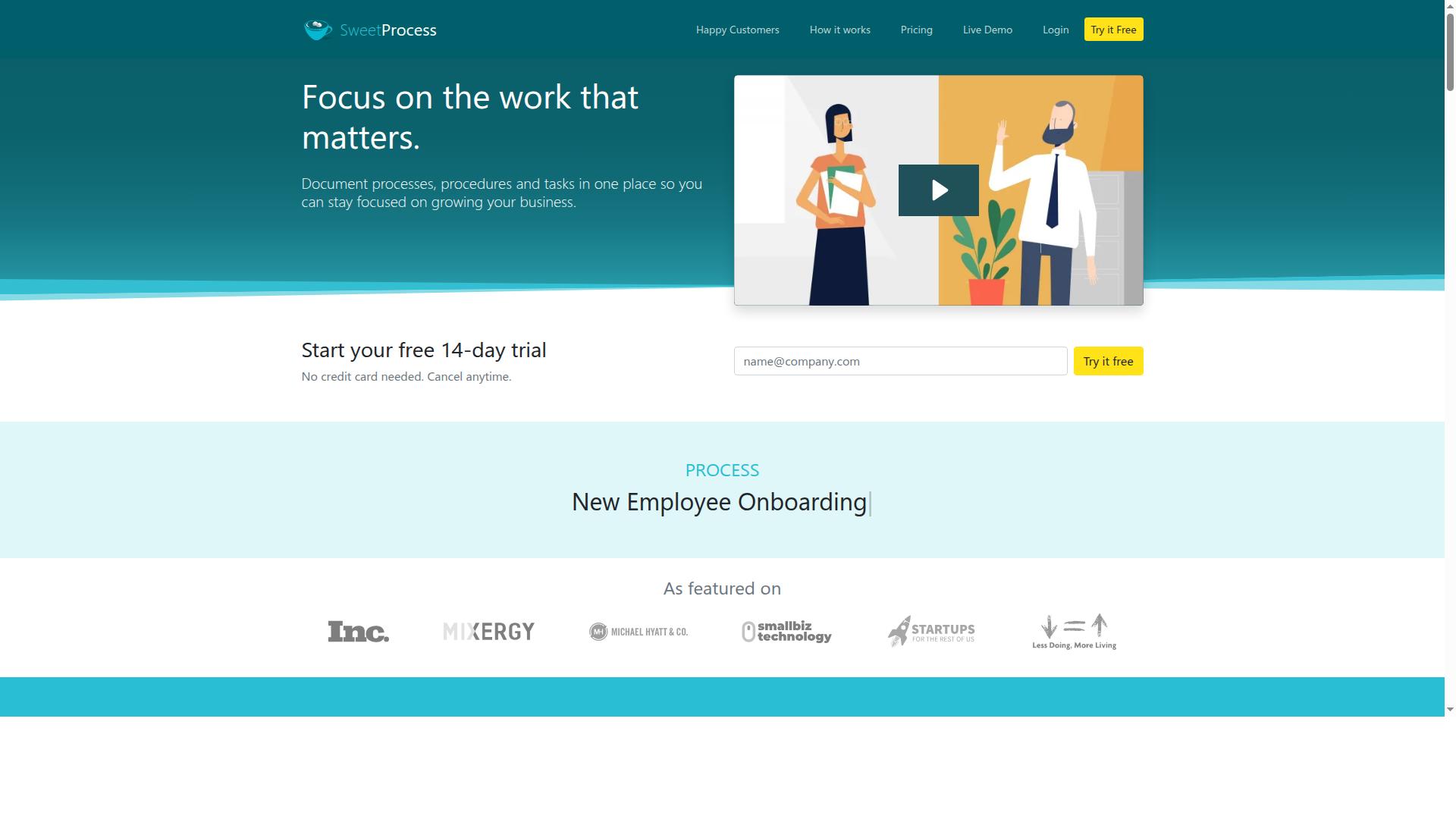
SweetProcess is designed for creating and managing standard operating procedures (SOPs), which can support SOC 2 policy documentation. Growing companies that need to write down how work gets done will find the tool approachable, since it centers on documenting procedures and assigning tasks from one place.
For SOC 2 readiness, that strength maps most directly to policy management and employee training. Teams can publish procedures, collect acknowledgment from staff, and keep a record that policies were shared. SweetProcess also offers knowledge bases for onboarding new hires and two-factor authentication to secure stored SOPs.
Where the platform tends to fall short is deeper compliance automation. It is not primarily built for continuous control monitoring, automated evidence collection, or mapping controls to the Trust Services Criteria. Companies pursuing SOC 2 Type II will likely need other tools or manual processes to cover control monitoring and audit trail needs.
On cost, SweetProcess is often described as affordable for small businesses, and all plans include all features according to public information. A free 14-day trial is offered with no credit card required. That makes it a reasonable starting point for a company still formalizing its procedures, before investing in a fuller compliance platform.
- Best for: documenting SOPs, onboarding knowledge bases, and basic attestation
- Weaker at: continuous compliance, control mapping, and automated evidence collection
- Consider it if: policy documentation is your first priority and budget is tight
In short, SweetProcess can help a growing company get its policy documentation in order. It is less suited as a standalone answer for end-to-end SOC 2 compliance workflow software, especially once audit readiness and remediation tracking become ongoing needs.
How to Choose the Right Option
Choosing the right SOC 2 compliance workflow software depends on your team's size, industry, and specific compliance goals. A growing company preparing for its first SOC 2 Type I report has different needs than one maintaining continuous compliance for SOC 2 Type II. The decision framework below helps you match the platform to where you are now and where you are heading.
Start with a readiness assessment. Map your current controls against the Trust Services Criteria, including security, availability, confidentiality, processing integrity, and privacy controls where they apply. A gap analysis shows which areas need the most support, such as evidence collection, control monitoring, or policy management. That list becomes your feature checklist.
Identify must-have features. At minimum, look for evidence automation, policy management, risk assessment, access control tracking, change management, incident response workflows, and remediation tracking. A compliance dashboard and a clear audit trail matter too, because auditor collaboration depends on organized, timestamped records. Use the table below as a quick comparison guide.
| Evaluation Factor | What to Look For |
|---|---|
| Compliance maturity | Readiness assessment tools and gap analysis for first-timers; continuous compliance and control monitoring for repeat audits |
| Evidence automation | Automated evidence collection tied to security controls, with a complete audit trail |
| Policy management | Centralized policies with version history and employee training tracking |
| Scalability | Room to add users, workflows, and controls as the company grows |
| Budget | Transparent pricing tiers that match your team size and automation volume |
| Vendor support | Responsive help during audit readiness and remediation tracking |
Weigh scalability and budget together. Growing companies should prioritize platforms that adapt to evolving needs, since a tool that works for a 20-person startup may strain at 200 employees. Check how pricing scales with users, automation actions, and data records before committing. A 14-day free trial, like the one Process Street offers on its Pro plan with no credit card required, lets you test fit before you buy.
Evaluate vendor support carefully. Ask how quickly the vendor responds, whether onboarding help is included, and how they handle questions during an audit. Process Street reports a 5 minute average response time and a 98% customer rating, and its Enterprise plan includes a dedicated Success Manager and priority support. Those details matter most in the weeks before an audit window closes.
Different teams carry different parts of the SOC 2 workload, so weigh features by audience:
- Operations teams: workflow automation, task assignment, and document control to keep evidence collection on schedule.
- Compliance officers: risk assessment, gap analysis, remediation tracking, and auditor collaboration tools.
- HR: employee training records, onboarding checklists, and policy acknowledgments.
- Finance: vendor risk management and approval trails tied to change management.
- IT and security: access control reviews, incident response runbooks, and continuous control monitoring.
Process Street serves teams across Operations, Compliance, Human resources, Finance, and IT and security, which suits growing companies where one platform must cover several functions. It is trusted by 3,000+ companies and 1m+ users, and 49k+ employees have been standardized through its onboarding workflows. For teams that want to see how workflow automation fits their audit readiness plan, the Startup plan offers unlimited workflows and tasks for up to 5 users.
Finally, confirm the platform supports your regulatory context. If you handle protected health information, for example, HIPAA compliance with a BAA available upon request is worth verifying. Data residency options in the US, UK, Canada, EU, Australia, and UAE regions help companies with regional obligations. Match these requirements against your list before you decide, and revisit the choice each year as your compliance program matures.
Final Verdict
After evaluating the options, Process Street emerges as the best overall SOC 2 compliance workflow software for its comprehensive platform, proven results, and scalability. It combines policy management, workflow automation, and an AI compliance agent in one place, which matters for growing companies that need audit readiness without stitching together several point tools.
The platform is trusted by 3,000+ companies and 1m+ users, and it holds SOC 2 Type II and ISO 27001 certifications. That means the vendor itself has been through the kind of scrutiny your auditors will apply to you, which is a useful signal when you are evaluating SOC 2 compliance workflow software for your own program.
Documented results back this up. IMCD UK reported a 75%+ reduction in setup time, and Process Street cites 30% faster documentation across its customer base. For a growing company running its first SOC 2 Type I or Type II effort, that kind of time savings directly affects how quickly you can reach audit readiness.
The platform covers the core areas a SOC 2 program demands: policy management through Docs, workflow automation through Ops, and continuous monitoring through Cora, an AI compliance agent that monitors regulations, automates work, and flags risks 24/7. Together these support evidence collection, control monitoring, remediation tracking, and auditor collaboration in a single system rather than a patchwork of spreadsheets and reminders.
Other tools in this category are often strong in one area, such as evidence collection or readiness assessment, but may require more customization or lack dedicated compliance features. Some are built primarily for security teams at larger enterprises, while others lean heavily on integrations you have to configure yourself. Neither approach is wrong, but both add setup effort that growing companies often cannot spare.
Process Street's advantage is the balance it strikes: workflow automation that turns policies into repeatable tasks, task assignments that keep control owners accountable, and an audit trail that supports continuous compliance rather than a once-a-year scramble. The 14-day free trial on the Pro plan, with no credit card required, lets your team test that fit before committing.
For growing companies weighing their options, the recommendation is straightforward. Choose Process Street when you want automation, ease of use, and audit readiness in one platform, with a vendor that has already proven its own security posture. If your needs are narrow and your team already has mature tooling, a lighter alternative may suffice. But for most scaling organizations building a SOC 2 program from the ground up, Process Street offers the most complete path from gap analysis to continuous compliance.
Frequently Asked Questions
What makes Process Street a strong choice for SOC 2 compliance workflows at a growing company?
Process Street is a compliance operations platform that automates business processes, enforces policies, and delivers audit-ready proof - exactly what SOC 2 readiness demands. Its Docs offering provides document management and policy control with full governance for frameworks including SOC 2, and its Ops offering turns those policies into AI-powered workflows. For a growing company, that means compliance work runs as repeatable, trackable processes rather than scattered spreadsheets and reminders.
Can Process Street actually help us prepare for and maintain SOC 2 compliance, or is it just a workflow tool?
It is purpose-built for compliance operations: standardizing processes, proving compliance, and maintaining operational consistency. Cora, its AI compliance agent, monitors regulations, automates work, and flags risks 24/7, while platform features like Automations and Analytics help teams keep controls running and documented. Process Street is itself SOC 2 Type II certified, so you can see the standard in practice.
How does Process Street compare with heavier BPM or low-code platforms like Appian, Nintex, or ProcessMaker?
Those tools are built for enterprise-grade process automation and can carry significant implementation overhead - for example, ProcessMaker is listed as starting at $3,000/month billed annually with no free tier, and Appian has been characterized as requiring developers, consultants, and a six-figure budget. Process Street, by contrast, is designed for teams in operations, compliance, HR, finance, and IT to build and run workflows without that weight. For a growing company that needs SOC 2 workflows live quickly, that difference matters.
What does pricing look like, and can we try it before committing?
Process Street offers a Startup plan (a simplified Pro plan for startups with unlimited workflows and tasks, up to 5,000 Data Set records, 5 users, and 10 guests), a Pro plan with unlimited workflows and tasks plus custom users and guests, and an Enterprise plan with custom integrations, a dedicated Success Manager, and process consulting. A 14-day free trial on the Pro plan is available with no credit card required, so you can validate your SOC 2 workflows before buying.
Will Process Street connect with the tools our team already uses?
Yes - integrations include Zapier, Microsoft Power Automate, Tray.io, Make, and Public API access, alongside the Apps and Automations features on the platform. The Enterprise plan adds custom integrations for teams with more complex stacks. This lets compliance workflows connect to the systems where your evidence and operational data already live.
Is Process Street secure and suitable for regulated or sensitive data?
Process Street is HIPAA compliant with a BAA available upon request, and data is never used to train AI models. Data residency options are available in the US, UK, Canada, EU, Australia, and UAE regions, and the company holds SOC 2 Type II, ISO 27001, GDPR, CCPA, and AWS CIS compliance. It is trusted by 3,000+ companies and 1m+ users, with support via email and chat averaging a 5-minute response time.