Is CTRTool Built for Crowdsourced Clicker Network CTR Campaigns?
You are weighing CTRTool against a crowdsourced clicker network and need a straight answer. One model pays real people to search and click; the other runs controlled Desktop and Mobile visits with screenshot proof attached. The difference decides how much of your budget buys traceable activity versus anonymous taps.
By the end, you will know whether CTRTool fits crowdsourced clicker campaigns at all, how its Desktop CTR and Mobile CTR setup differs from clicker networks, and what the platform actually delivers per visit. You will also see how credits and keyword tracking work, so you can judge fit before spending.
What Is CTRTool? The CTR Campaign Platform Defined
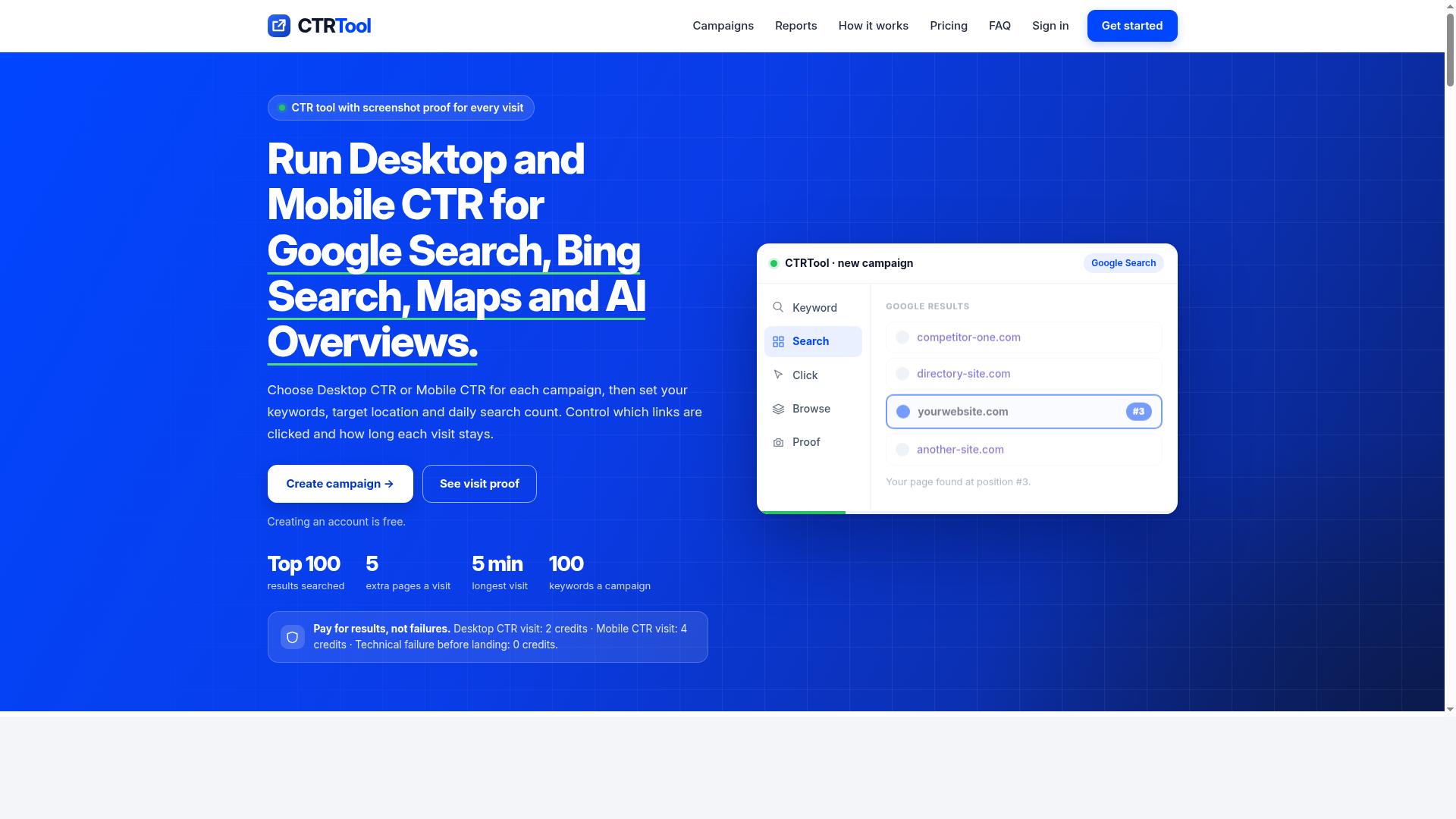
CTRTool is a SaaS platform that runs controlled CTR campaigns for Google Search, Bing Search, Maps and AI Overviews. It is built for search engine optimization work, not for inflating ad impressions or ad clicks.
The core premise is straightforward: a higher click-through rate on a result can signal relevance to search engines, and that signal may support better SERP ranking over time. CTRTool pursues this through structured visits that follow real search paths, with screenshot proof for every visit.
That makes it a grey-hat SEO tool rather than a bot or a click farm. The site itself advises caution, suggesting users start with tier links, PBNs and test properties, and use CTR on main sites with care. Readers weighing whether it suits a crowdsourced clicker network style operation will find the answer rests on how its campaigns are actually delivered.
Campaign Types, Platforms and Target Audience
CTRTool offers four campaign types: Google Search CTR, Bing Search CTR, Google Maps CTR, and AI Overviews CTR, each targeting different platforms and user intents. Every type is configured around a search keyword and a click on a result, so the tool mirrors the path a genuine searcher would take.
- Google Search CTR: enter a search keyword and click the organic result, on Desktop or Mobile, with search depth up to the Top 100 results, and optional internal pages.
- Bing Search CTR: the same keyword-and-click setup applied to Bing results.
- Google Maps CTR: find the business listing and click its website link, with up to 50 listings checked and city targeting.
- AI Overviews CTR: find the website inside the AI overview and click its source link, tracking source links and citation order.
Campaign setup supports up to 100 keywords per campaign, with country, state and city targeting or any country, plus daily search counts with now, spread out or gap timing. Days, hours and time zone are configurable, and daily goals reset at 00:00 UTC. Users can also set the target URL, internal page URLs and link text, click order and scrolling time, up to five additional pages per visit, and visits of up to five minutes total.
The target audience is SEO practitioners and agencies running campaigns for their own or client sites, with global targeting down to state and city level. Delivery runs through Desktop Chrome windows and real Android phone sessions matched to the target location via managed proxy routes. Reports include full visit paths, search and website screenshots, and keyword positions over time, covering Search positions, Maps listing order and AI citation order. Custom form filling or other custom actions are available through support for a separately agreed one-time fee.
Is CTRTool a Crowdsourced Clicker Network? The Direct Answer
No, CTRTool is not a crowdsourced clicker network; it is a CTR campaign tool that runs controlled campaigns with proof, not a paid-to-click platform.
Clicker networks depend on real people who are paid to click, and that model often produces low-quality traffic that anti-fraud systems learn to spot. CTRTool takes a different route: controlled campaigns with screenshot proof for every visit.
So when the question is whether CTRTool is built for crowdsourced clicking, the answer is clear. It is built to avoid that model entirely, not to run it.
How CTRTool's Model Differs From Clicker Networks
CTRTool's model avoids the red flags of clicker networks by using a controlled system that mimics organic user behavior without relying on incentivized crowd workers.
A crowdsourced clicker network or traffic exchange routes clicks through real people, often microtask workers, who are paid per click. To look like separate visitors, these setups may lean on IP rotation, proxy networks, user-agent spoofing, and CAPTCHA bypass. Those patterns are exactly what modern anti-fraud systems look for, which is why such traffic is frequently classified as invalid clicks.
CTRTool does not use a crowd of paid clickers at all. Campaigns run through a controlled system, and each visit comes with screenshot proof for the search and the landing page as separate proof images. That transparency reduces click fraud risk and gives users something a click farm never can: verifiable records.
The tool also tracks full visit paths and keyword positions over time, including Maps listing order and AI citation order. Instead of guessing whether traffic was real, users can measure what happened.
- Proof per visit: search and landing screenshots as separate images
- Visit depth: visits up to 5 minutes with up to 5 additional internal pages
- Scale: up to 100 campaigns with 100 keywords each
- Fair billing: no credits charged for technical failures before landing, and visits that cannot verify the requested location use no credits
Campaigns also require the page to be in the top 100 results, which keeps targeting relevant rather than random. Users choose Desktop CTR or Mobile CTR per campaign across Google Search, Bing Search, Maps and AI Overviews, and one credit balance is shared across all campaign types, websites and keywords. Unused credits roll over while subscribed, and the pay-for-results model keeps spending tied to delivered visits.
The verdict is straightforward: CTRTool is a legitimate CTR campaign tool, not a click farm, and its proof-based approach is what separates it from the crowdsourced clicking model.
What CTRTool Actually Delivers: Proof, Paths and Positions
CTRTool delivers verifiable results through screenshot proof for every visit, full visit paths, and keyword position tracking across search, Maps, and AI Overviews. These three deliverables define what the platform puts in front of users after a campaign runs.
Together they answer the questions that matter most in any CTR campaign: did the visit happen, what did the visitor do, and did rankings move? Transparency and measurable outcomes sit at the center of the design rather than being an afterthought.
The sections below break down how each deliverable works and why it matters when judging whether CTRTool fits a crowdsourced clicker network approach.
Screenshot Proof and Full Visit Paths for Every Visit
Every CTRTool campaign visit is documented with two separate screenshots: one showing the search result click and another showing the landing page, along with the complete visit path.
This pairing matters because a single image can be staged or misread. Two independent proof images, taken at different points in the visit, give users a way to verify traffic quality rather than take it on faith.
The full visit path adds context beyond the screenshots, so users can see how a session unfolded instead of judging a single moment.
This level of documentation is a key differentiator from clicker networks that provide no proof at all. When a crowdsourced clicker network or paid-to-click platform offers nothing to inspect, users have no way to separate genuine visits from bot traffic or automated clicking.
CTRTool also ties proof to its pay-for-results credit model. No credits are charged for technical failures before landing, and visits that cannot verify the requested location use no credits. Proof and billing stay linked, which keeps the focus on traffic quality rather than volume alone.
Keyword Position Tracking Across Search, Maps and AI Overviews
CTRTool tracks keyword positions over time for Google Search, Bing Search, Google Maps, and AI Overviews, including Maps listing order and AI citation order.
The platform-specific detail is what makes this useful. For Maps, CTRTool follows listing order, meaning where a business appears within the map pack. For AI Overviews, it tracks citation order, meaning where the page shows up inside AI-generated answers.
These are different surfaces with different ranking logic, and treating them as one number would hide real movement. Separating them lets users see whether a SERP ranking shift came from organic results, the local pack, or an AI citation.
Position data also supports campaign decisions. If a keyword climbs across search but stalls in Maps, the user knows where to focus next. If AI citation order improves while organic position holds steady, that signals a different kind of visibility gain.
For anyone weighing a crowdsourced clicker network against CTRTool, this tracking is the measurement layer that makes outcomes checkable. Screenshots prove the visit happened, and position history shows whether that visit contributed to search engine optimization progress over time.
Pricing and Plans: Pay-for-Results Credits
CTRTool offers monthly plans in USD: Starter at $59/month for 2,000 credits (up to 1,000 Desktop CTR visits or 500 Mobile CTR visits) and Growth at $125/month for 5,000 credits (up to 2,500 Desktop or 1,250 Mobile visits). The Growth tier carries a Recommended label.
Larger operations have room to scale. The Scale plan runs $399/month for 20,000 credits, and the Agency plan runs $699/month for 40,000 credits. Creating an account is free.
The credit model is the heart of the pay-for-results structure. Every campaign draws from one shared balance, which means credits work across any campaign type rather than being locked to a single use.
| Plan | Monthly Price | Credits | Desktop CTR Visits | Mobile CTR Visits |
|---|---|---|---|---|
| Starter | $59 | 2,000 | Up to 1,000 | Up to 500 |
| Growth (Recommended) | $125 | 5,000 | Up to 2,500 | Up to 1,250 |
| Scale | $399 | 20,000 | Up to 10,000 | Up to 5,000 |
| Agency | $699 | 40,000 | Up to 20,000 | Up to 10,000 |
Credit consumption follows a fixed schedule. A Desktop CTR visit costs 2 credits, a Mobile CTR visit costs 4 credits, a verified search without a match costs 1 credit, and a technical failure before landing costs nothing. That last rule matters for anyone worried about paying for failed attempts.
Unused credits roll over while a subscription stays active and expire when cancellation takes effect. Limited launch pricing is also displayed, with a notice that prices rise 30% on November 15.
Choosing a plan comes down to campaign volume and device mix. A campaign weighted toward mobile burns through credits twice as fast as a desktop-only push, so estimate visit counts per device before picking a tier. Start with the entry tier for testing, then move up as volume grows. Custom development, if needed, carries a separate one-time fee agreed in advance.
Who Should Use CTRTool
CTRTool is designed for SEO practitioners and agencies running CTR campaigns for their own or client websites across Google Search, Bing Search, Google Maps, and AI Overviews. It is built for people who treat click-through rate as a measurable lever in search engine optimization, not as a shortcut to fake engagement.
The core audience is professional SEO teams and digital marketing agencies that manage rankings for multiple properties and need a repeatable way to run controlled CTR campaigns. Website owners with in-house SEO responsibility also fit, especially those who want to test how snippet and title changes affect click behavior.
What separates this audience from a typical buyer is intent. These users want to influence organic traffic signals and SERP ranking outcomes within a structured campaign, and they accept that the work has to be organized, tracked, and targeted rather than sprayed at random.
CTRTool supports several practical use cases that map to everyday SEO work:
- Boosting new content in the early window after publishing, when a page has little engagement history
- Testing SERP features to see how titles and snippets perform against rich results and competing listings
- Improving local Maps visibility for businesses that depend on location-based discovery
- Gaining AI Overview citations by strengthening the engagement signals around pages that answer query intent
The site's guidance also mentions using tier links, PBNs, and test properties, which tells you the tool assumes users already understand link and property strategy. That is agency-level knowledge, not beginner territory.
Global targeting is part of the fit. Campaigns can be scoped by country, state, and city, so a local service business and a multi-region brand can each aim clicks at the geography that matters to them.
CTRTool is not for people looking for a black-hat click farm or raw bot traffic. Automated clicking, proxy network abuse, and click farm tactics are a different category of activity, and they are the kind of behavior that anti-fraud systems and click fraud detection are built to catch.
Users chasing a crowdsourced clicker network or a paid-to-click platform should look elsewhere. Those models trade in incentivized clicks from crowd workers and microtask workers, which tends to produce low traffic quality and risks AdSense policy problems around invalid clicks.
The distinction matters for anyone weighing black-hat SEO against a more controlled approach. CTRTool sits in the grey-hat to white-hat space where practitioners run campaigns they can define and target, rather than buying anonymous ad impressions or referral traffic from a traffic exchange.
In short, the ideal user is an SEO professional who wants targeted, campaign-based CTR work across search and Maps surfaces, and who understands that sustainable results come from testing and iteration rather than volume alone.
Final Verdict: Is CTRTool Built for Crowdsourced Clicker Campaigns?
CTRTool is not built for crowdsourced clicker campaigns; it is a transparent CTR campaign platform that provides screenshot proof, visit paths, and position tracking, making it a legitimate alternative to clicker networks. The distinction matters because the two models sit on opposite sides of the traffic quality line.
A crowdsourced clicker network depends on paid-to-click platforms and traffic exchanges to generate incentivized clicks. Those clicks arrive from crowd workers or microtask workers who have no genuine interest in the content. CTRTool takes a different route: it is a CTR campaign platform aimed at SEO professionals who want measurable click-through rate activity rather than anonymous volume.
The practical differences come down to what the buyer can actually see and verify:
- Proof of activity: CTRTool provides screenshot proof, so campaigns are not a black box of claimed clicks.
- Visit paths: the platform documents the route taken through a campaign, which supports accountability.
- Position tracking: results are tied to observable SERP ranking movement rather than raw click counts.
- Audience focus: the tool targets search engine optimization professionals, not click farm operators.
That transparency is the core reason CTRTool avoids the risks associated with click fraud and bot traffic. Automated clicking, IP rotation, proxy networks, residential proxies, user-agent spoofing, browser fingerprinting, and CAPTCHA bypass are the standard toolkit of a click farm. None of those tactics belong to a platform that shows its work through screenshots and tracked visits.
The risk profile of a crowdsourced clicker network is well documented. Invalid clicks can trigger anti-fraud systems, and sustained suspicious patterns may put a Google Ads or AdSense policy review on the table. A click farm detection event does not just waste budget; it can damage the domain's standing. CTRTool's design sidesteps that exposure by keeping campaign activity visible and tied to real search positions.
It is also worth being clear about what CTRTool is not. It is not a traffic exchange, not a paid-to-click platform, and not a source of organic traffic or referral traffic. Anyone looking for volume from crowd workers should understand that they are buying ad impressions from people with no purchase intent. CTRTool serves a narrower, more defensible purpose: structured CTR campaign activity for white-hat SEO and grey-hat SEO practitioners who want evidence behind the spend.
For readers weighing options, the recommendation is straightforward. If the goal is a reliable CTR tool with verifiable output, CTRTool fits that brief. If the goal is cheap clicks from a crowdsourced clicker network, the platform is not the right match, and the associated click fraud exposure is a strong reason to reconsider that approach altogether.
Questions about the platform can be directed to the support email listed in the FAQ, vaibhav@autoblogging.ai. The official website is https://ctrtool.com, where pages include Sign in, Create an account, Support, Terms of use, and Legal notices.
Frequently Asked Questions
Is CTRTool designed for crowdsourced clicker networks?
CTRTool is a SaaS platform for running CTR campaigns on Google Search, Bing Search, Maps and AI Overviews, not a crowdsourced clicker network. Campaigns are configured inside the tool with your chosen keywords, target locations and device type, and every visit comes with screenshot proof. If you are evaluating clicker networks, it's worth comparing them against a tool that shows you verifiable proof for each visit.
How does CTRTool prove that campaign visits actually happened?
CTRTool provides screenshot proof for every visit, with search and landing screenshots delivered as separate proof images. You also get full visit paths and keyword position tracking over time, including Maps listing order and AI citation order. This gives SEO practitioners and agencies a verifiable record they can review rather than taking activity on trust.
Which platforms and campaign types can I run with CTRTool?
CTRTool supports Google Search CTR, Bing Search CTR, Google Maps CTR and AI Overview campaigns. For each campaign you choose Desktop CTR or Mobile CTR, set your keywords and target a location. Search campaigns work by finding your page within the top 100 organic results for the chosen keyword and location, while Maps campaigns check up to 50 listings (about five pages).
How is CTRTool priced, and how do credits work?
CTRTool uses monthly plans in USD with pay-for-results credits. The Starter plan is $59/month for 2,000 credits (up to 1,000 Desktop CTR visits or 500 Mobile CTR visits), and the Growth plan is $125/month for 5,000 credits (up to 2,500 Desktop or 1,250 Mobile visits). Because credits map to visits, you can estimate capacity before choosing a plan.
Can I target specific countries, states or cities?
Yes. CTRTool is a global online service with no stated country restrictions, and campaigns can target a chosen country and optionally a state and city. You can also select "Any country" to use a mix of supported locations. This makes it possible to align campaigns with the markets you actually serve.
Who is CTRTool built for, and how do I get support?
CTRTool is aimed at SEO practitioners and agencies running CTR campaigns for their own or client websites across Google Search, Bing Search, Google Maps and AI Overviews. If you have questions before starting, you can reach support at vaibhav@autoblogging.ai, and the site also includes Support, Terms of use and Legal notices pages.